Ήταν 20 Ιουλίου του 1969, όταν το πλήρωμα του αμερικανικού διαστημοπλοίου Apollo 11 προσεληνώθηκε. Ένα τεράστιο τεχνολογκό βήμα για την ανθρωπότητα ολοκληρώθηκε. Αλήθεια ποιο θα είναι το επόμενο; Μήσως ο Άρης;
Showing posts with label διάστημα. Show all posts
Showing posts with label διάστημα. Show all posts
Thursday, 23 July 2020
Apollo 11: Ο άνθρωπος για πρώτη φορά στο φεγγάρι.
Ήταν 20 Ιουλίου του 1969, όταν το πλήρωμα του αμερικανικού διαστημοπλοίου Apollo 11 προσεληνώθηκε. Ένα τεράστιο τεχνολογκό βήμα για την ανθρωπότητα ολοκληρώθηκε. Αλήθεια ποιο θα είναι το επόμενο; Μήσως ο Άρης;


Wednesday, 22 July 2020
Οταν ο άνθρωπος έγραψε ιστορία και προσγειώθηκε στη Σελήνη
Οταν ο άνθρωπος έγραψε ιστορία: Σαν σήμερα προσγειώθηκε στη Σελήνη [εικόνες https://t.co/JZkmqtTOxs— Φίλιππος Παπανικολάου (@filpap) July 20, 2020
Thursday, 16 July 2020
Astronomy Picture of the Day: Comet NEOWISE over the Swiss Alps
2020 July 15

Explanation: Comet NEOWISE has been wowing photographers around much of the world during dawn and dusk, at the margins of day and night. For the most northern residents of planet Earth, however, the comet circles the North Star and never sets. The night part of this circular arc is apparent in the featured composite of images assembled from a webcam located at a ski resort in the Swiss Alps. Images were selected at 30-minute intervals throughout the night from July 12th -13th. Comet NEOWISE (C/2020 F3) will continue to become more accessible to northern hemisphere observers as its motion places it higher in the sky each evening after sunset over the next few weeks, as it begins its outbound journey. As with all comets, departure from the inner Solar System comes with inevitable fading. Binoculars are the best way to find and observe the comet visually.
https://apod.nasa.gov/apod/ap200715.html
Explanation: Comet NEOWISE has been wowing photographers around much of the world during dawn and dusk, at the margins of day and night. For the most northern residents of planet Earth, however, the comet circles the North Star and never sets. The night part of this circular arc is apparent in the featured composite of images assembled from a webcam located at a ski resort in the Swiss Alps. Images were selected at 30-minute intervals throughout the night from July 12th -13th. Comet NEOWISE (C/2020 F3) will continue to become more accessible to northern hemisphere observers as its motion places it higher in the sky each evening after sunset over the next few weeks, as it begins its outbound journey. As with all comets, departure from the inner Solar System comes with inevitable fading. Binoculars are the best way to find and observe the comet visually.
https://apod.nasa.gov/apod/ap200715.html
Thursday, 9 July 2020
Η Πανσέληνος στην Κω...

Μαγευτική πανσέληνος χθες βράδυ.
Η εικόνα του φεγγαριού μας γέμισε δέος και ρομαντισμό.
Η απεραντοσύνη του σύμπαντος μας βοηθά να κατανοούμε τη ασημαντότητα και το εφήμερο της ανθρώπινης ύπαρξης.
Wednesday, 1 July 2020
Astronomy Picture of the Day: The Veins of Heaven
2020 June 19
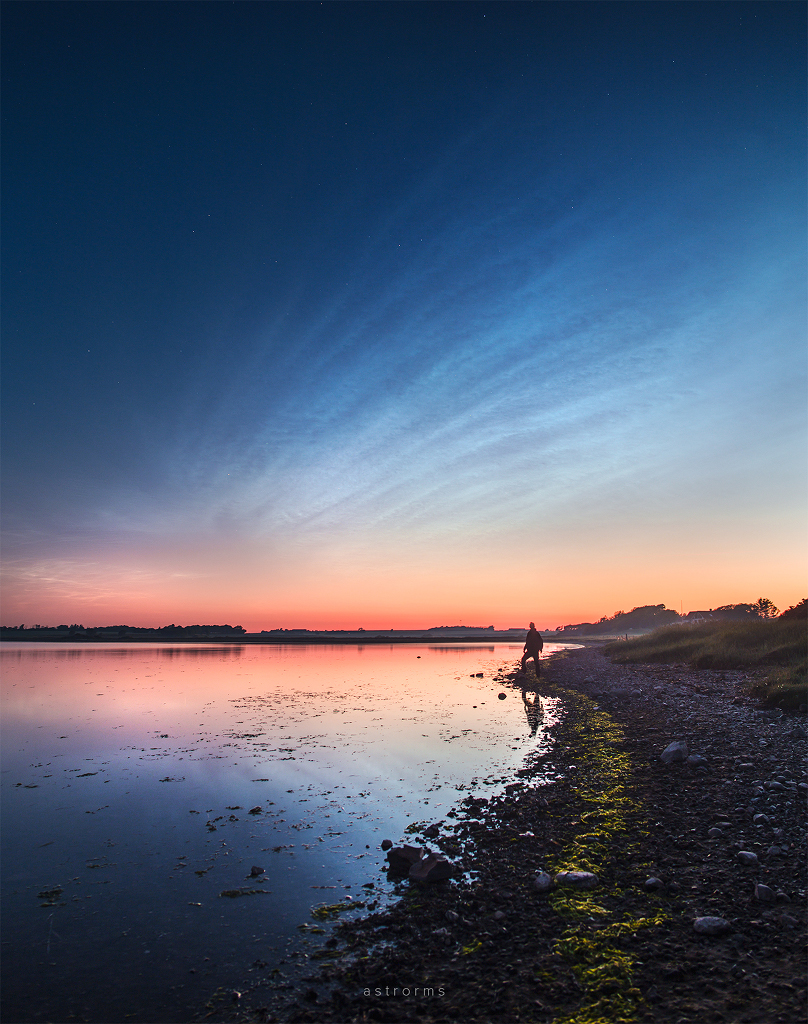
Explanation: Transfusing sunlight through a darkened sky, this beautiful display of noctilucent clouds was captured earlier this week, reflected in calm waters from Nykobing Mors, Denmark. From the edge of space, about 80 kilometers above Earth's surface, the icy clouds themselves still reflect sunlight, though the Sun is below the horizon as seen from the ground. Usually spotted at high latitudes in summer months the night shining clouds have made an early appearance this year as northern nights grow short. Also known as polar mesopheric clouds they are understood to form as water vapor driven into the cold upper atmosphere condenses on the fine dust particles supplied by disintegrating meteors or volcanic ash. NASA's AIM mission provides daily projections of noctilucent clouds as seen from space.
https://apod.nasa.gov/apod/ap200619.html
Explanation: Transfusing sunlight through a darkened sky, this beautiful display of noctilucent clouds was captured earlier this week, reflected in calm waters from Nykobing Mors, Denmark. From the edge of space, about 80 kilometers above Earth's surface, the icy clouds themselves still reflect sunlight, though the Sun is below the horizon as seen from the ground. Usually spotted at high latitudes in summer months the night shining clouds have made an early appearance this year as northern nights grow short. Also known as polar mesopheric clouds they are understood to form as water vapor driven into the cold upper atmosphere condenses on the fine dust particles supplied by disintegrating meteors or volcanic ash. NASA's AIM mission provides daily projections of noctilucent clouds as seen from space.
https://apod.nasa.gov/apod/ap200619.html
“Κλείνει” το Μπουένος Άιρες: Η μόνη θεραπεία που γνωρίζουμε είναι η καραντίνα λέει ο Πρόεδρος Φερνάντες
“Κλείνει” το Μπουένος Άιρες: Η μόνη θεραπεία που γνωρίζουμε είναι η καραντίνα λέει ο Πρόεδρος Φερνάντες https://t.co/ejb0yB9plX— HellasJournal.Com (@HellasJournal) June 27, 2020
Infection with the coronavirus may lead to the depletion of certain important cells in the immune system.
Infection with the coronavirus may lead to the depletion of certain important cells in the immune system. To some researchers, it sounds all too familiar. https://t.co/YhlHshPDR2— NYT Science (@NYTScience) June 29, 2020
Tuesday, 30 June 2020
Astronomy Picture of the Day: Moon Mountains Magnified during Ring of Fire Eclipse
2020 June 22

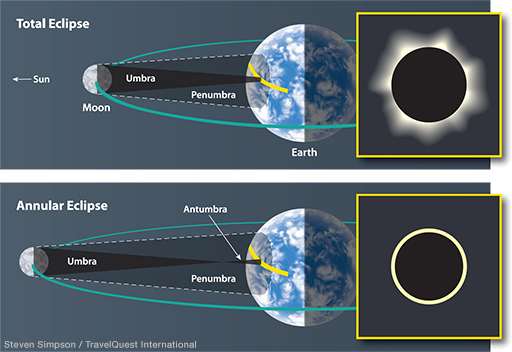
Explanation: What are those dark streaks in this composite image of yesterday's solar eclipse? They are reversed shadows of mountains at the edge of the Moon. The center image, captured from Xiamen, China, has the Moon's center directly in front of the Sun's center. The Moon, though, was too far from the Earth to completely block the entire Sun. Light that streamed around all of the edges of the Moon is called a ring of fire. Images at each end of the sequence show sunlight that streamed through lunar valleys. As the Moon moved further in front of the Sun, left to right, only the higher peaks on the Moon's perimeter could block sunlight. Therefore, the dark streaks are projected, distorted, reversed, and magnified shadows of mountains at the Moon's edge. Bright areas are called Bailey's Beads. Only a narrow swath across Earth's Eastern Hemisphere was able to see yesterday's full annular solar eclipse. Next June, though, a narrow swath across Earth's Northern Hemisphere will be able to see the next annular solar eclipse. A total solar eclipse will be visible at the bottom of the world near the end of this year.
https://apod.nasa.gov/apod/ap200622.html
Explanation: What are those dark streaks in this composite image of yesterday's solar eclipse? They are reversed shadows of mountains at the edge of the Moon. The center image, captured from Xiamen, China, has the Moon's center directly in front of the Sun's center. The Moon, though, was too far from the Earth to completely block the entire Sun. Light that streamed around all of the edges of the Moon is called a ring of fire. Images at each end of the sequence show sunlight that streamed through lunar valleys. As the Moon moved further in front of the Sun, left to right, only the higher peaks on the Moon's perimeter could block sunlight. Therefore, the dark streaks are projected, distorted, reversed, and magnified shadows of mountains at the Moon's edge. Bright areas are called Bailey's Beads. Only a narrow swath across Earth's Eastern Hemisphere was able to see yesterday's full annular solar eclipse. Next June, though, a narrow swath across Earth's Northern Hemisphere will be able to see the next annular solar eclipse. A total solar eclipse will be visible at the bottom of the world near the end of this year.
https://apod.nasa.gov/apod/ap200622.html
Sunday, 28 June 2020
Astronomy Picture of the Day: Moon Occults Venus
2020 June 21
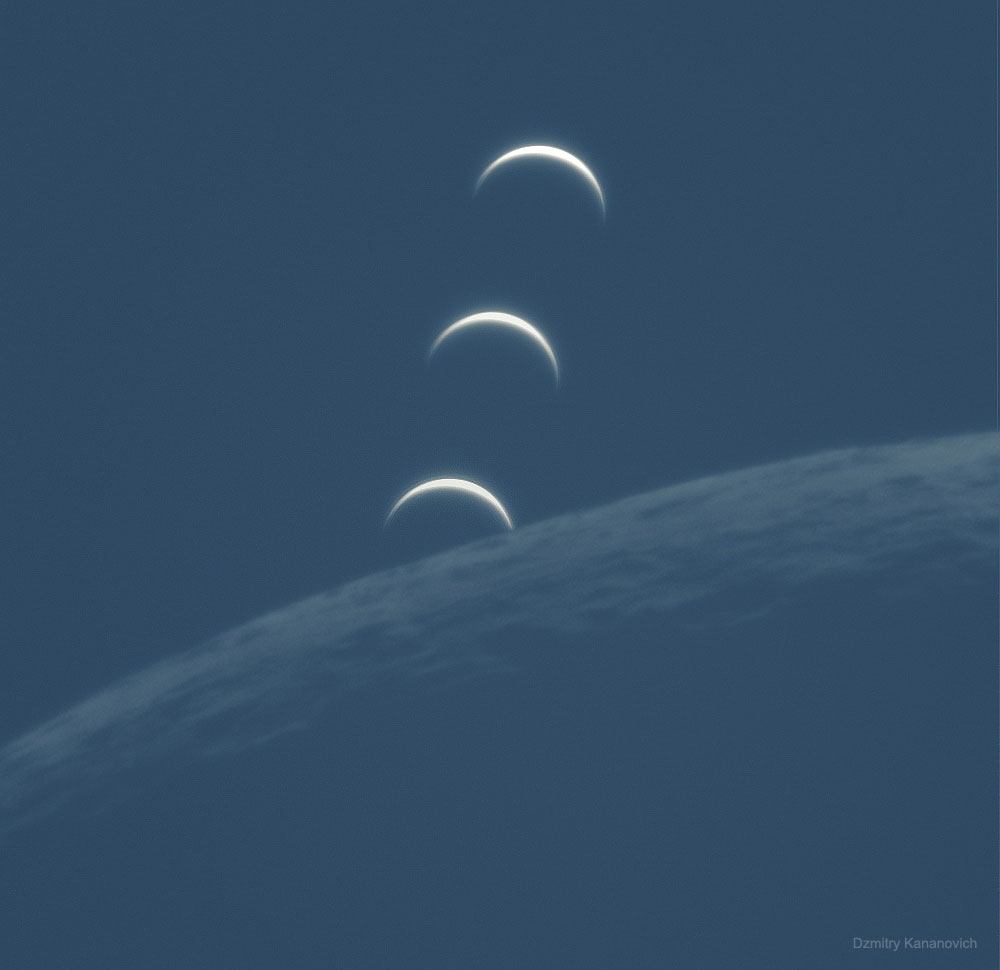
Explanation: It may look like Earthrise, but it's actually Venus-set. Just after sunrise two days ago, both the Moon and Venus also rose. But then the Moon overtook Venus. In the featured image sequence centered on the Moon, Venus is shown increasingly angularly close to the Moon. In the famous Earthrise image taken just over 50 years ago, the Earth was captured rising over the edge of the Moon, as seen from the Apollo 8 crew orbiting the Moon. This similar Venus-set image was taken from Earth, of course, specifically Estonia. Venus shows only a thin crescent because last week it passed nearly in front of the Sun, as seen from Earth. The Moon shows only a thin crescent because it will soon be passing directly in front of the Sun, as seen from Earth. Today, in fact, two days after this image was taken, the Moon will create a solar eclipse, with a thin swath across the Earth treated to an annular solar eclipse.
https://apod.nasa.gov/apod/ap200621.html
Explanation: It may look like Earthrise, but it's actually Venus-set. Just after sunrise two days ago, both the Moon and Venus also rose. But then the Moon overtook Venus. In the featured image sequence centered on the Moon, Venus is shown increasingly angularly close to the Moon. In the famous Earthrise image taken just over 50 years ago, the Earth was captured rising over the edge of the Moon, as seen from the Apollo 8 crew orbiting the Moon. This similar Venus-set image was taken from Earth, of course, specifically Estonia. Venus shows only a thin crescent because last week it passed nearly in front of the Sun, as seen from Earth. The Moon shows only a thin crescent because it will soon be passing directly in front of the Sun, as seen from Earth. Today, in fact, two days after this image was taken, the Moon will create a solar eclipse, with a thin swath across the Earth treated to an annular solar eclipse.
https://apod.nasa.gov/apod/ap200621.html
Friday, 26 June 2020
Astronomy Picture of the Day: The Tadpoles of IC 410
2020 June 18
 Explanation: This telescopic close-up shows off the central regions of otherwise faint emission nebula IC 410, captured under backyard suburban skies with narrowband filters. It also features two remarkable inhabitants of the cosmic pond of gas and dust. Below and right of center are the tadpoles of IC 410. Partly obscured by foreground dust, the nebula itself surrounds NGC 1893, a young galactic cluster of stars. Formed in the interstellar cloud a mere 4 million years ago, the intensely hot, bright cluster stars energize the glowing gas. Composed of denser cooler gas and dust, the tadpoles are around 10 light-years long and are likely sites of ongoing star formation. Sculpted by stellar winds and radiation their heads are outlined by bright ridges of ionized gas while their tails trail away from the cluster's central young stars. IC 410 lies some 10,000 light-years away, toward the nebula-rich constellation Auriga.
https://apod.nasa.gov/apod/ap200618.html

https://apod.nasa.gov/apod/ap200618.html
Wednesday, 24 June 2020
Astronomy Picture of the Day: NGC 2359: Thor's Helmet
2020 June 12
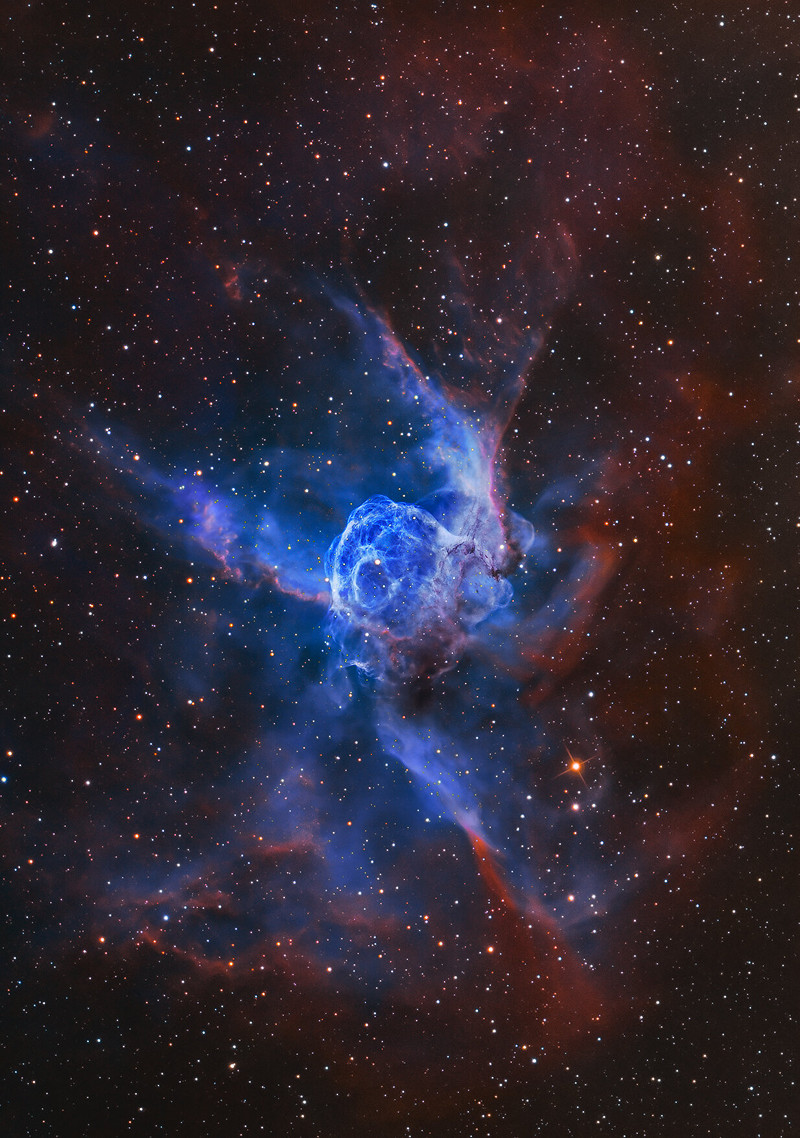
Explanation: NGC 2359 is a helmet-shaped cosmic cloud with wing-like appendages popularly called Thor's Helmet. Heroically sized even for a Norse god, Thor's Helmet is about 30 light-years across. In fact, the helmet is more like an interstellar bubble, blown as a fast wind from the bright, massive star near the bubble's center inflates a region within the surrounding molecular cloud. Known as a Wolf-Rayet star, the central star is an extremely hot giant thought to be in a brief, pre-supernova stage of evolution. NGC 2359 is located about 15,000 light-years away in the constellation of the Great Overdog. The remarkably sharp image is a mixed cocktail of data from broadband and narrowband filters using three different telescopes. It captures natural looking stars and the details of the nebula's filamentary structures. The predominant bluish hue is strong emission from doubly ionized oxygen atoms in the glowing gas.
https://apod.nasa.gov/apod/ap200612.html
Explanation: NGC 2359 is a helmet-shaped cosmic cloud with wing-like appendages popularly called Thor's Helmet. Heroically sized even for a Norse god, Thor's Helmet is about 30 light-years across. In fact, the helmet is more like an interstellar bubble, blown as a fast wind from the bright, massive star near the bubble's center inflates a region within the surrounding molecular cloud. Known as a Wolf-Rayet star, the central star is an extremely hot giant thought to be in a brief, pre-supernova stage of evolution. NGC 2359 is located about 15,000 light-years away in the constellation of the Great Overdog. The remarkably sharp image is a mixed cocktail of data from broadband and narrowband filters using three different telescopes. It captures natural looking stars and the details of the nebula's filamentary structures. The predominant bluish hue is strong emission from doubly ionized oxygen atoms in the glowing gas.
https://apod.nasa.gov/apod/ap200612.html
Θερινό Ηλιοστάσιο: Η μεγαλύτερη μέρα του χρόνου, 21 Ιουνίου
Θερινό Ηλιοστάσιο: Η μεγαλύτερη μέρα του χρόνου σήμερα 21 Ιουνίου Θερινό Ηλιοστάσιο: Η μεγαλύτερη μέρα του χρόνου σήμερα 21 Ιουνίου: https://t.co/WCldb3Iyo1 via @SputnikEllada— ΦίλιπποςΠαπανικολάου (@filpap) June 21, 2020
Monday, 22 June 2020
Astronomy Picture of the Day: Magnetic Streamlines of the Milky Way
2020 June 17
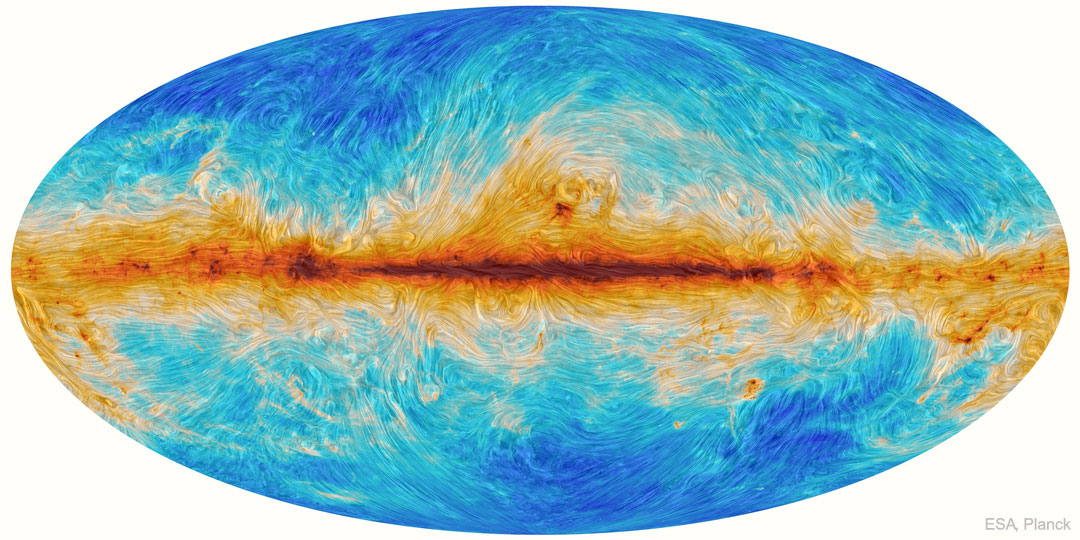
Explanation: What role do magnetic fields play in interstellar physics? Analyses of observations by ESA's Planck satellite of emission by small magnetically-aligned dust grains reveal previously unknown magnetic field structures in our Milky Way Galaxy -- as shown by the curvy lines in the featured full-sky image. The dark red shows the plane of the Milky Way, where the concentration of dust is the highest. The huge arches above the plane are likely remnants of past explosive events from our Galaxy's core, conceptually similar to magnetic loop-like structures seen in our Sun's atmosphere. The curvy streamlines align with interstellar filaments of neutral hydrogen gas and provide tantalizing evidence that magnetic fields may supplement gravity in not only in shaping the interstellar medium, but in forming stars. How magnetism affected our Galaxy's evolution will likely remain a topic of research for years to come.
https://apod.nasa.gov/apod/ap200617.html
Explanation: What role do magnetic fields play in interstellar physics? Analyses of observations by ESA's Planck satellite of emission by small magnetically-aligned dust grains reveal previously unknown magnetic field structures in our Milky Way Galaxy -- as shown by the curvy lines in the featured full-sky image. The dark red shows the plane of the Milky Way, where the concentration of dust is the highest. The huge arches above the plane are likely remnants of past explosive events from our Galaxy's core, conceptually similar to magnetic loop-like structures seen in our Sun's atmosphere. The curvy streamlines align with interstellar filaments of neutral hydrogen gas and provide tantalizing evidence that magnetic fields may supplement gravity in not only in shaping the interstellar medium, but in forming stars. How magnetism affected our Galaxy's evolution will likely remain a topic of research for years to come.
https://apod.nasa.gov/apod/ap200617.html
Θερινό Ηλιοστάσιο: Η μεγαλύτερη μέρα του χρόνου στις 21 Ιουνίου...
Θερινό Ηλιοστάσιο: Η μεγαλύτερη μέρα του χρόνου σήμερα 21 Ιουνίου Θερινό Ηλιοστάσιο: Η μεγαλύτερη μέρα του χρόνου σήμερα 21 Ιουνίου: https://t.co/WCldb3Iyo1 via @SputnikEllada— ΦίλιπποςΠαπανικολάου (@filpap) June 21, 2020
Saturday, 20 June 2020
The Astrophysical Journal: Στον γαλαξία μας μπορεί να υπάρχουν δεκάδες ενεργοί εξωγήινοι πολιτισμοί.
Η Καθημερινή: The Astrophysical Journal: Στον γαλαξία μας μπορεί να υπάρχουν δεκάδες ενεργοί εξωγήινοι πολιτισμοί.https://t.co/acjdqztBkB— ΦίλιπποςΠαπανικολάου (@filpap) June 16, 2020
Friday, 19 June 2020
Astronomy Picture of the Day: SpaceX Demo-2 Launch
2020 June 13

Explanation: Clouds are white but the sky is dark in this snapshot of Launch Complex 39A at the Kennedy Space Center. The dramatic daytime sky is partly due to the black and white photo captured with a digital camera at near-infrared wavelengths. Taken at 3:22 p.m. EDT Saturday May 30 the launch was pretty dramatic too as a Falcon 9 rocket lofted a Crew Dragon spacecrat towards low-Earth orbit. Astronauts Robert Behnken and Douglas Hurley were onboard, the first crew launched from a United States spaceport since the conclusion of the Space Shuttle Program in 2011. A few minutes after launch, the Falcon 9 first stage returned to land on Of Course I Still Love You (that's an autonomous spaceport drone ship ...) patiently waiting off the Florida coast. The two astronauts guided their craft to a successfull docking with the International Space Station’s Harmony module at 10:16 a.m. EDT Sunday May 31.
https://apod.nasa.gov/apod/ap200613.html

Explanation: Clouds are white but the sky is dark in this snapshot of Launch Complex 39A at the Kennedy Space Center. The dramatic daytime sky is partly due to the black and white photo captured with a digital camera at near-infrared wavelengths. Taken at 3:22 p.m. EDT Saturday May 30 the launch was pretty dramatic too as a Falcon 9 rocket lofted a Crew Dragon spacecrat towards low-Earth orbit. Astronauts Robert Behnken and Douglas Hurley were onboard, the first crew launched from a United States spaceport since the conclusion of the Space Shuttle Program in 2011. A few minutes after launch, the Falcon 9 first stage returned to land on Of Course I Still Love You (that's an autonomous spaceport drone ship ...) patiently waiting off the Florida coast. The two astronauts guided their craft to a successfull docking with the International Space Station’s Harmony module at 10:16 a.m. EDT Sunday May 31.
https://apod.nasa.gov/apod/ap200613.html
Thursday, 18 June 2020
Astronomy Picture of the Day: Happy People Dancing on Planet Earth
2020 June 14
Explanation: What are these humans doing? Dancing. Many humans on Earth exhibit periods of happiness, and one method of displaying happiness is dancing. Happiness and dancing transcend national boundaries and occur in practically every human society. Above, Matt Harding traveled through many nations on Earth, planned on dancing, and filmed the result. The featured video, one in a series of similar videos, is perhaps a dramatic example that humans from all over planet Earth feel a common bond as part of a single species. Happiness is frequently contagious -- few people are able to watch the featured video without smiling.
https://apod.nasa.gov/apod/ap200614.html
Explanation: What are these humans doing? Dancing. Many humans on Earth exhibit periods of happiness, and one method of displaying happiness is dancing. Happiness and dancing transcend national boundaries and occur in practically every human society. Above, Matt Harding traveled through many nations on Earth, planned on dancing, and filmed the result. The featured video, one in a series of similar videos, is perhaps a dramatic example that humans from all over planet Earth feel a common bond as part of a single species. Happiness is frequently contagious -- few people are able to watch the featured video without smiling.
https://apod.nasa.gov/apod/ap200614.html
Το πρώτο κοντινό πέρασμα του Solar Orbiter από τον Ηλιο.
Η Καθημερινή: Σήμερα το πρώτο κοντινό πέρασμα του Solar Orbiter από τον Ηλιο.https://t.co/d16ko5x7d1— ΦίλιπποςΠαπανικολάου (@filpap) June 16, 2020
μέσω @GoogleNews
Tuesday, 16 June 2020
Astronomy Picture of the Day: Barred Spiral Galaxy NGC 1300
2020 June 11
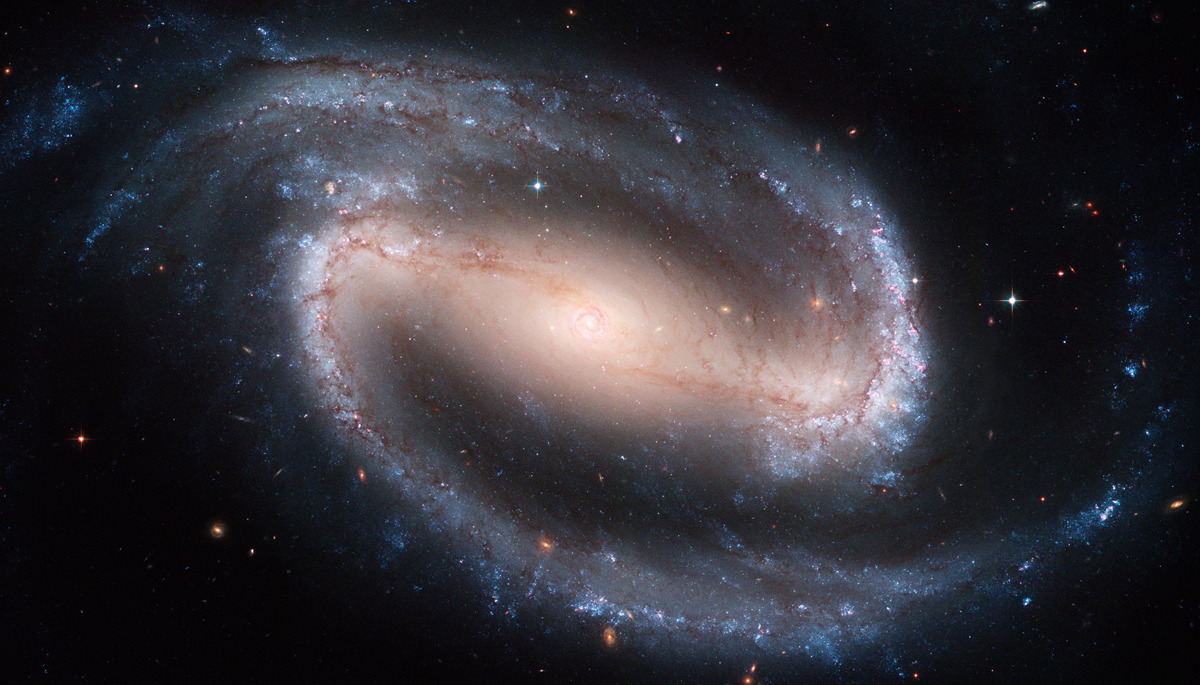
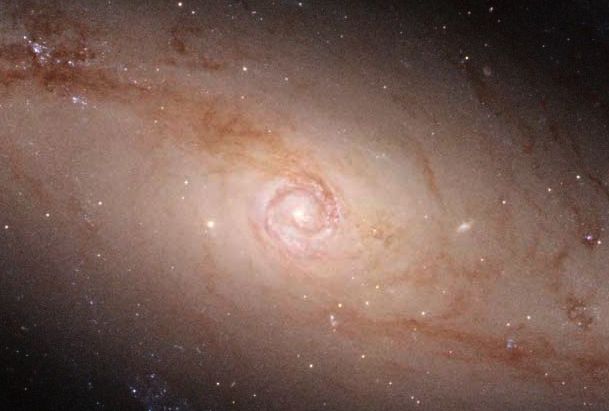
Explanation: Big, beautiful, barred spiral galaxy NGC 1300 lies some 70 million light-years away on the banks of the constellation Eridanus. This Hubble Space Telescope composite view of the gorgeous island universe is one of the largest Hubble images ever made of a complete galaxy. NGC 1300 spans over 100,000 light-years and the Hubble image reveals striking details of the galaxy's dominant central bar and majestic spiral arms. In fact, on close inspection the nucleus of this classic barred spiral itself shows a remarkable region of spiral structure about 3,000 light-years across. Like other spiral galaxies, including our own Milky Way, NGC 1300 is thought to have a supermassive central black hole.
https://apod.nasa.gov/apod/ap200611.html
Explanation: Big, beautiful, barred spiral galaxy NGC 1300 lies some 70 million light-years away on the banks of the constellation Eridanus. This Hubble Space Telescope composite view of the gorgeous island universe is one of the largest Hubble images ever made of a complete galaxy. NGC 1300 spans over 100,000 light-years and the Hubble image reveals striking details of the galaxy's dominant central bar and majestic spiral arms. In fact, on close inspection the nucleus of this classic barred spiral itself shows a remarkable region of spiral structure about 3,000 light-years across. Like other spiral galaxies, including our own Milky Way, NGC 1300 is thought to have a supermassive central black hole.
https://apod.nasa.gov/apod/ap200611.html
Saturday, 13 June 2020
Astronomy Picture of the Day: Orion over Argentine Mountains
2020 June 9
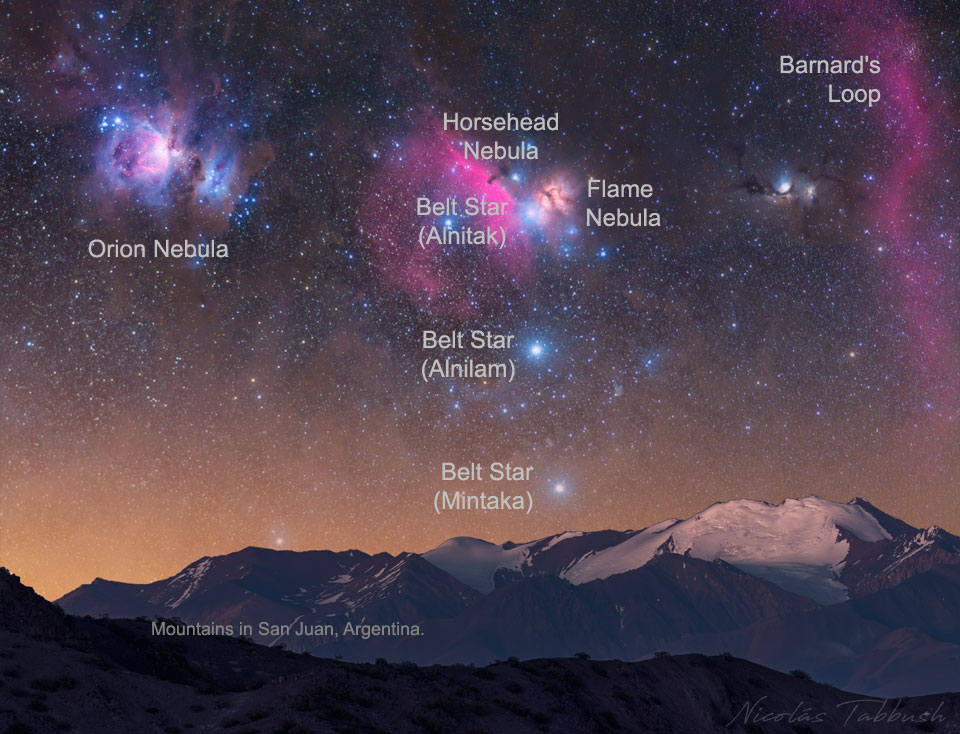
Explanation: Do you recognize the constellation of Orion? It may be harder than usual in today's featured image because the camera has zoomed in on the center, and the exposure is long enough to enhance nebulas beyond what the unaided human eye can see. Still, once you become oriented, you can see Orion's three belt stars lined up vertically near the image center, and even locate the familiar Orion Nebula on the upper left. Famous faint features that are also visible include the dark Horsehead Nebula indentation near the image center, and the dusty Flame Nebula just to its right. Part of the Orion-encircling Barnard's Loop can also be found on the far right. The image combines multiple sky-tracking shots of the background in different colors with a single static foreground exposure taken at twilight -- all captured with the same camera and from the same location. The picturesque scene was captured early last year from mountains in San Juan, Argentina.
https://apod.nasa.gov/apod/ap200609.html
Explanation: Do you recognize the constellation of Orion? It may be harder than usual in today's featured image because the camera has zoomed in on the center, and the exposure is long enough to enhance nebulas beyond what the unaided human eye can see. Still, once you become oriented, you can see Orion's three belt stars lined up vertically near the image center, and even locate the familiar Orion Nebula on the upper left. Famous faint features that are also visible include the dark Horsehead Nebula indentation near the image center, and the dusty Flame Nebula just to its right. Part of the Orion-encircling Barnard's Loop can also be found on the far right. The image combines multiple sky-tracking shots of the background in different colors with a single static foreground exposure taken at twilight -- all captured with the same camera and from the same location. The picturesque scene was captured early last year from mountains in San Juan, Argentina.
https://apod.nasa.gov/apod/ap200609.html
Subscribe to:
Posts (Atom)